
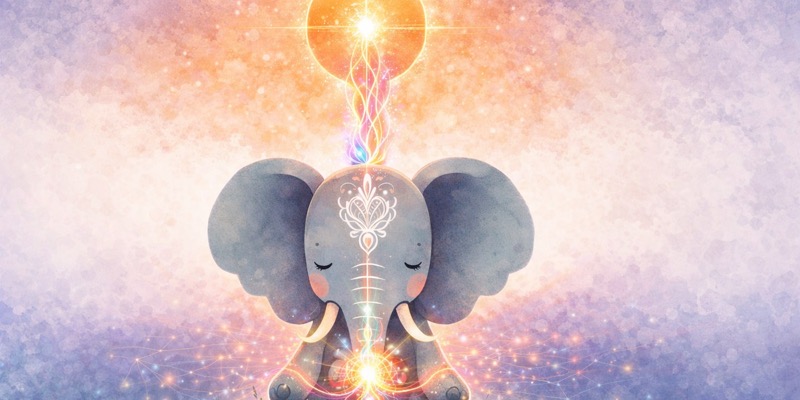
There is a part of my work that I have held close for a long time. Not because I was ashamed of it, but because it felt sacred. Personal. Like something that needed to be shared at the right time, in the right way.
I think that time is now.
This is the part of me that believes healing happens not only through the mind, but through the heart. Through the body. Through the quiet, invisible currents of energy that move through all of us, whether we have language for it or not.
And if I'm honest, I have my mother to thank for this.
Where It Began
My mother is an energy practitioner and a heartfulness trainer. She has been doing this work for over two decades now. And in all those years, she has never once charged anyone for her time. Not once. She supports people every single day. She sits with them, meditates with them, holds space for them. I have never seen her say no to someone who needs an energy-integrated session.
That kind of quiet, unwavering devotion shaped me before I had words for it.
She introduced meditation to us when I was three years old. Not the kind you see on apps or in corporate wellness programs. Heart-centred meditation. A practice rooted in the heartfulness tradition, where we focus on the heart centre as a place of guidance, and hold the belief that we are all connected to a source of unconditional love and light.
I didn't fully understand it as a child. But I felt it. And that feeling stayed with me through every stage of my life, through every heartbreak and every healing, until it eventually wove itself into the way I practise therapy today.
The Heart as a Centre of Knowing
Heart-centred meditation is beautifully simple. You bring your attention to the heart. Not the physical organ, but the felt centre of your being, the space in your chest where love lives, where grief lives, where knowing lives. And you rest there.
No mantra. No striving. Just presence.
What happens over time is something subtle but powerful. The mind begins to quiet. Not because you've forced it to, but because the heart has become louder. Clearer. More trustworthy.
And here is where something remarkable emerges: what the heartfulness tradition calls connection to the source, modern psychology has been arriving at through its own doors.
Where East Meets West
In IFS therapy, we talk about Self, the calm, compassionate, curious presence that lives beneath all of our protective parts. Self is who we are when fear steps back. It's the leader within. The one who can hold pain without being consumed by it.
In humanistic and person-centred therapy, Carl Rogers spoke of the authentic self. The self that emerges when conditions of worth are removed and a person is met with unconditional positive regard.
In compassion-focused therapy, Paul Gilbert describes a compassionate self that can be cultivated, a way of being that soothes the threat system and opens the door to connection and safety.
What strikes me, again and again, is how closely these Western frameworks mirror what the heartfulness tradition has been pointing to for generations: that there is a place within each of us that is already whole. Already loving. Already wise. And that healing is not about becoming someone new, but about returning to what was always there.
Energy integration is the bridge between these worlds. It doesn't replace the psychological frameworks. It breathes life into them.
When Talk Therapy Finds Itself in a Loop
I want to speak to something I see often in my work, because I think many people will recognise it.
Traditional talk therapy is powerful. The relationship, the witnessing, the making sense of our stories. It can be deeply transformative. And yet, there are moments when talk therapy can find itself in a loop. A client arrives carrying complex emotions: grief tangled with anger, shame layered with loneliness, fear knotted into the body. We talk about it. We explore it. We name it. And sometimes, naming it helps enormously.
But sometimes, talking about it further seems to amplify it further. The loop tightens. The client feels stuck, not because they aren't trying, but because the pain has settled somewhere that words alone can't reach. It lives in the chest, in the pit of the stomach, in the tightness of the jaw. It lives in the energy body.
This is where energy-integrated work offers something different.
It doesn't try to think its way out of the loop. It gently undoes the loop from the inside. It brings calmer, gentler energies into the body on what I can only describe as a soul level. Not through force. Not through analysis. But through presence, intention, and the quiet intelligence of the heart.
What This Looks Like in Practice
Energy-integrated sessions can take many forms. Two of the most common ways I work are:
Guided visualisation. I gently guide you into a safe internal space where you can meet the parts of yourself that are holding pain. We don't rush. We don't push. We simply create the conditions for your inner system to soften and reorganise at its own pace. Many people describe this as feeling like a deep internal exhale, as if something that had been clenched for years finally had permission to let go.
Heart-centred meditation. We focus together on the heart centre, inviting a gentle awareness to settle there. This practice draws from the heartfulness tradition I grew up in. It's not about emptying the mind or achieving a state. It's about arriving in the heart and allowing whatever is there to be met with warmth. Over time, this practice creates space. Space between stimulus and response. Space between the pain and our reaction to it. Space to choose differently.
Both approaches can be woven into a broader therapeutic process. The body work supports the talk work. The energy work supports the emotional work. They are not separate. They are different doorways into the same room.
This Is Not About Belief
I want to be clear about something. You don't need to believe in energy work for it to touch you. You don't need to subscribe to any spiritual tradition or adopt any particular worldview. You just need to be willing to slow down, place your attention on your heart, and see what happens.
Some people feel warmth. Some feel emotion rising. Some feel nothing at first, and that's perfectly okay too. The heart doesn't demand that you believe in it. It simply waits for you to arrive.
A Sacred Offering
I share this part of my work with tenderness, because it is the part of me that feels closest to home. It is the part my mother planted in me when I was three years old, sitting in meditation without understanding why. It is the part that grew quietly alongside my clinical training, weaving itself into every session, every relationship, every moment of healing I've been privileged to witness.
Energy integration is not a technique I learned from a textbook. It is a way of being that was modelled for me by a divine feminine who holds a soul-level belief in her healing archetype. It was carried to me by my ancestors, whose wisdom lives quietly in everything I do. It has been shaped by a large community of people from all over the world who practise heartfulness with devotion and care. And it has been deepened by every single client who has shown the openness to receive this work and integrate it into their daily life.
If any part of this resonates with you, if you've felt the loop of talking and thinking and still feeling stuck, if you've wondered whether there's something deeper waiting to be met, I want you to know: there is.
It lives in your heart. It always has. And when we slow down enough to listen, it will show us the way. Not through fear, but through love. Not through thinking, but through feeling. Not through effort, but through surrender to what is already whole within us.